Musk raised his arm twice. The ADL lowered the alarm.
Section 1 of 9 · Introduction
Musk raised his arm twice. The ADL lowered the alarm.
A straight right arm. A lowered palm. A second gesture towards the crowd behind him. Historians called it a Nazi salute. The Anti-Defamation League called it enthusiasm. The recording survived both captions.
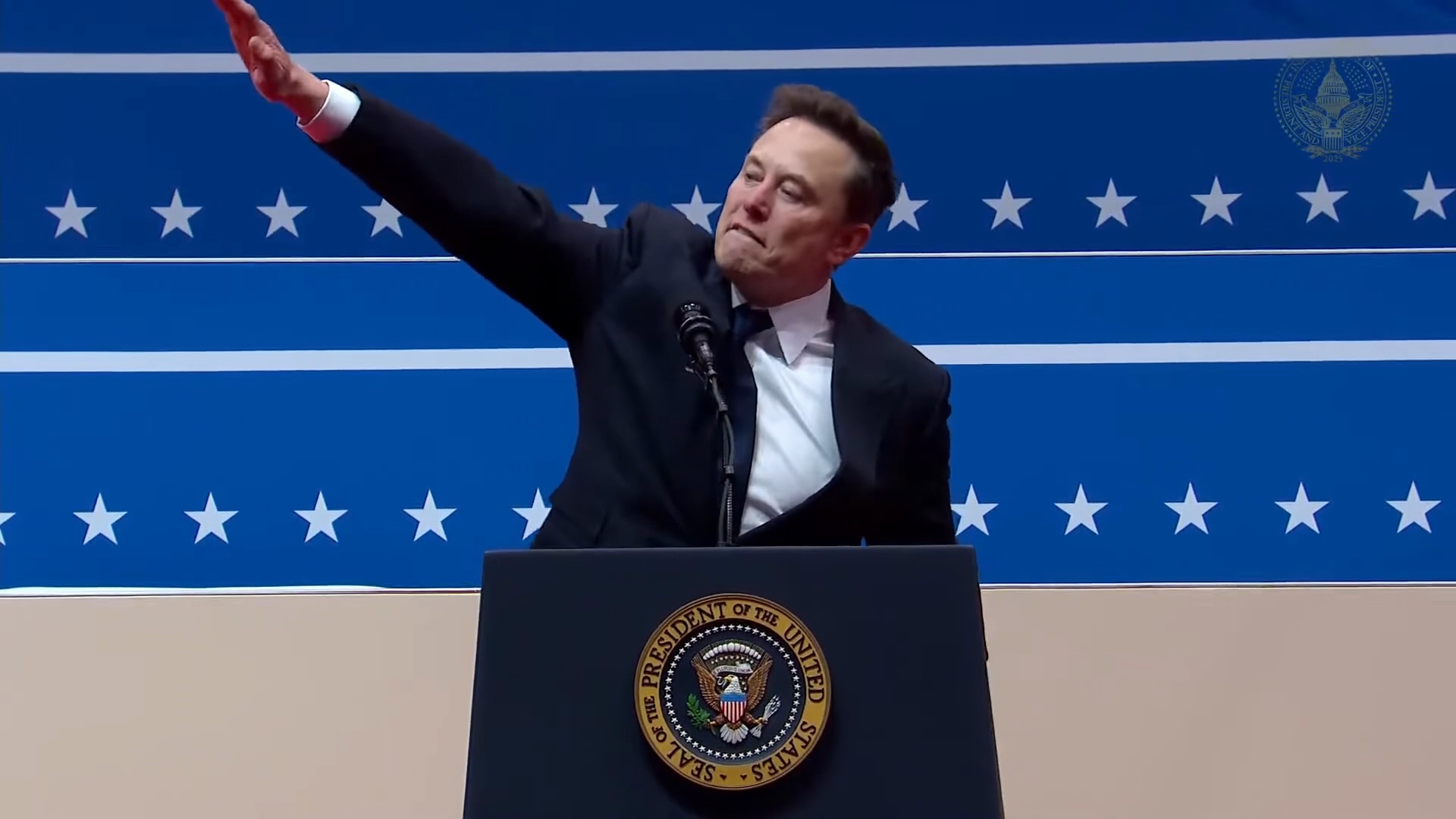

On 20 January 2025, at the Capital One Arena celebration following Donald Trump’s inauguration, Elon Musk placed his right hand against his chest and thrust his arm diagonally upwards, palm down. He turned and repeated the movement towards the audience behind him. He then said, “My heart goes out to you.” The sequence belongs in the record together: the hand, the repetition and the sentence. [1; 6]
NYU historian of fascism Ruth Ben-Ghiat identified the movement as a Nazi salute. Euronews reported her assessment alongside the ADL’s contrary interpretation. This was an explicit historical identification by a named scholar, not merely an anonymous social-media suspicion. It was also an interpretation of a public act, not a finding about Musk’s undisclosed thoughts. [4]
The Anti-Defamation League described an “awkward gesture in a moment of enthusiasm, not a Nazi salute.” Its statement asked the public to extend the benefit of the doubt. The organisation was entitled to make that assessment. Its standing as an antisemitism watchdog did not make the assessment self-proving. [2; 3]
Musk dismissed the accusation as a stale Hitler comparison. Later that week he posted puns involving Nazi leaders; the ADL condemned the jokes as trivialising the Holocaust. That later conduct is relevant to his public response. It does not retroactively establish the intention behind the earlier movement. [6; 7]
The invention examined here is a verbal shelter for a visible act. Calling the movement enthusiasm does more than describe Musk’s mood. It offers an innocent explanation for a gesture critics identified with fascism, then asks the audience to treat that explanation as the responsible conclusion.
There are three questions: what movement occurred, which historical gesture it resembles, and what Musk intended. The recording answers the first. Historical comparison informs the second. The third requires inference and supporting evidence. Uncertainty about intent cannot erase the movement or prohibit discussion of its resemblance.
That standard applies to accusation and defence alike. A recognisable posture does not establish a person’s entire ideology. An assurance of innocence does not make the resemblance disappear. Neither side receives access to the inside of a skull by finding a convenient caption.
The caption travels with borrowed authority. When a watchdog dismisses an interpretation, readers may reasonably assume some method sits behind the dismissal. In its 21 January follow-up, the Jewish Telegraphic Agency reported that the ADL was not explaining how it reached its conclusion. That is a dated reporting finding, not proof that no internal discussion occurred. [5]
The image also travels through selection. Reuters reported that a Fox clip Musk shared cut away from the podium during the first gesture. That editing choice changes what a viewer can inspect. The report does not establish that Musk ordered the cut or that the omission proves a concealed motive. [3]
The chain matters: an event recording becomes a still, a short clip, a repost and an argument about what the viewer is allowed to call it. The still preserves the arm position but loses the surrounding movement. The longer sequence restores the repetition and spoken thanks. A responsible account names those transformations instead of treating every circulating fragment as the same evidence.
The editorial concern is normalisation through an impossible evidentiary demand. If a public gesture cannot be criticised until private intention is conclusively recovered, the speaker gains a veto over its public meaning. That is an argument about accountability, not evidence that Musk privately designed such a strategy.
The strongest defence belongs in view. Musk was thanking supporters, touched his chest and spoke of his heart going out to the audience. Those details support an interpretation of an emphatic gesture of gratitude. The ADL endorsed that reading. Omitting the words would weaken the record. [6; 2]
The words do not settle every question. Ben-Ghiat identified a Nazi salute in the same public sequence. The existence of an innocent possible explanation does not require an audience to abandon historical recognition. Equally, her expertise is a reason to examine her assessment, not a substitute for the footage. [4]
Euronews also documented extremist approval of the gesture. That is evidence of reception: some extremists welcomed what appeared on screen. It does not demonstrate coordination with Musk or prove that their interpretation was his intention. A public symbol can acquire a political use without a recoverable agreement between speaker and audience. [4]
The later Nazi jokes are a separate trace. JTA’s 23 January report records the ADL’s criticism of that response after its initial defence of the gesture. The watchdog’s two positions concern different acts. Preserving the distinction makes the institutional record more precise; it does not excuse either act. [7]
The recording establishes the repeated straight-arm gesture and its surrounding speech. The dated responses establish a historian’s Nazi-salute identification, the ADL’s defence and Musk’s rejection of the accusation. The still cannot independently establish intent, ideological allegiance or a criminal offence.
This article’s judgment is that the resemblance warrants direct criticism and that the ADL’s reassurance deserves scrutiny. The title’s lowered alarm refers to the organisation’s public dismissal of the Nazi-salute interpretation. It does not allege a secret agreement, payment or coordinated cover-up.
The burden of explanation should be proportionate to the act and its setting. A prominent political supporter repeated a gesture associated by critics with fascism at an inauguration celebration. Asking him to account for that gesture is a demand for public accountability. It need not become a claim to know everything he believes.
What is answered, and what remains open. The sequence and the conflicting responses are documented. The private intention and the ADL’s internal decision process are not established by the materials presented here.
- What additional evidence, beyond the chest touch and spoken thanks already preserved, would distinguish an intended Nazi salute from an emphatic gesture of gratitude?
- What criteria and review process supported the ADL’s public dismissal, and would those criteria produce the same conclusion for a less influential speaker?
- As the full recording became a still, a clip and a repost, which versions preserved both gestures and the surrounding words, and which omitted material a reader needs to judge the act?
The arm needed no translation. The reassurance needed a methodology.
Sources
- Full speech preserved on Wikimedia Commons, 20 January 2025, with a link to the original event livestream; still, provenance and public-domain designation. Primary audiovisual record; archival descriptions do not establish intent.
- ADL statement on X, 20 January 2025. Primary public defence; wording corroborated in Reuters and Euronews. Direct X access may be restricted.
- Reuters, 21 January 2025: ADL response and the cutaway in the Fox clip Musk shared.
- Euronews, 21 January 2025: Ben-Ghiat’s identification, competing assessments and extremist reception.
- Andrew Lapin, Jewish Telegraphic Agency, 21 January 2025: follow-up on the ADL’s undisclosed reasoning. Its report concerns the response available at that time.
- Susan Carpenter, Spectrum News / NY1, 21 January 2025: sequence, surrounding words and Musk’s public rejection of the accusation.
- Andrew Lapin, Jewish Telegraphic Agency, 23 January 2025: later Nazi-themed jokes and the ADL’s condemnation; a distinct subsequent event.
Historical case focused on 20–23 January 2025. Claims of intent are attributed or marked as inference. The thumbnail is an AI-generated silhouette illustration with a red question mark on the podium, derived from the cited still, not an additional documentary record. The article lead retains the authentic video still. The closing line is editorial satire about the visible posture and the need to justify institutional reassurance, not a claim that intention has been conclusively proved.