The FBI’s 2025 table recorded 2,757 White-on-White murders without putting White America on trial.
Section 1 of 10 · Introduction
The FBI’s 2025 table recorded 2,757 White-on-White murders without putting White America on trial.
White victims, recorded offenders and the difference between identifying a crime and indicting a racial population.
By Al Agami · XORCIS.AI · 1 October 2026
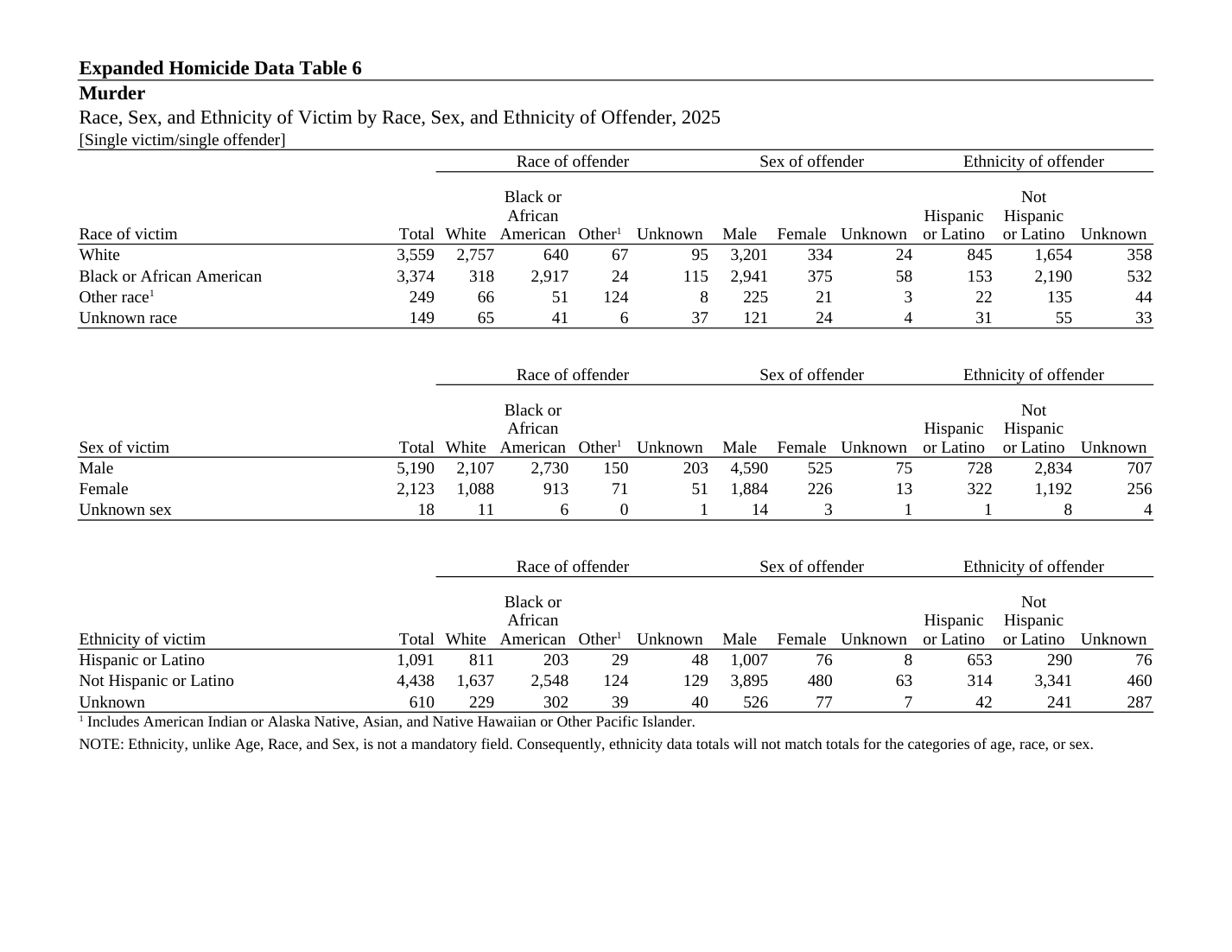
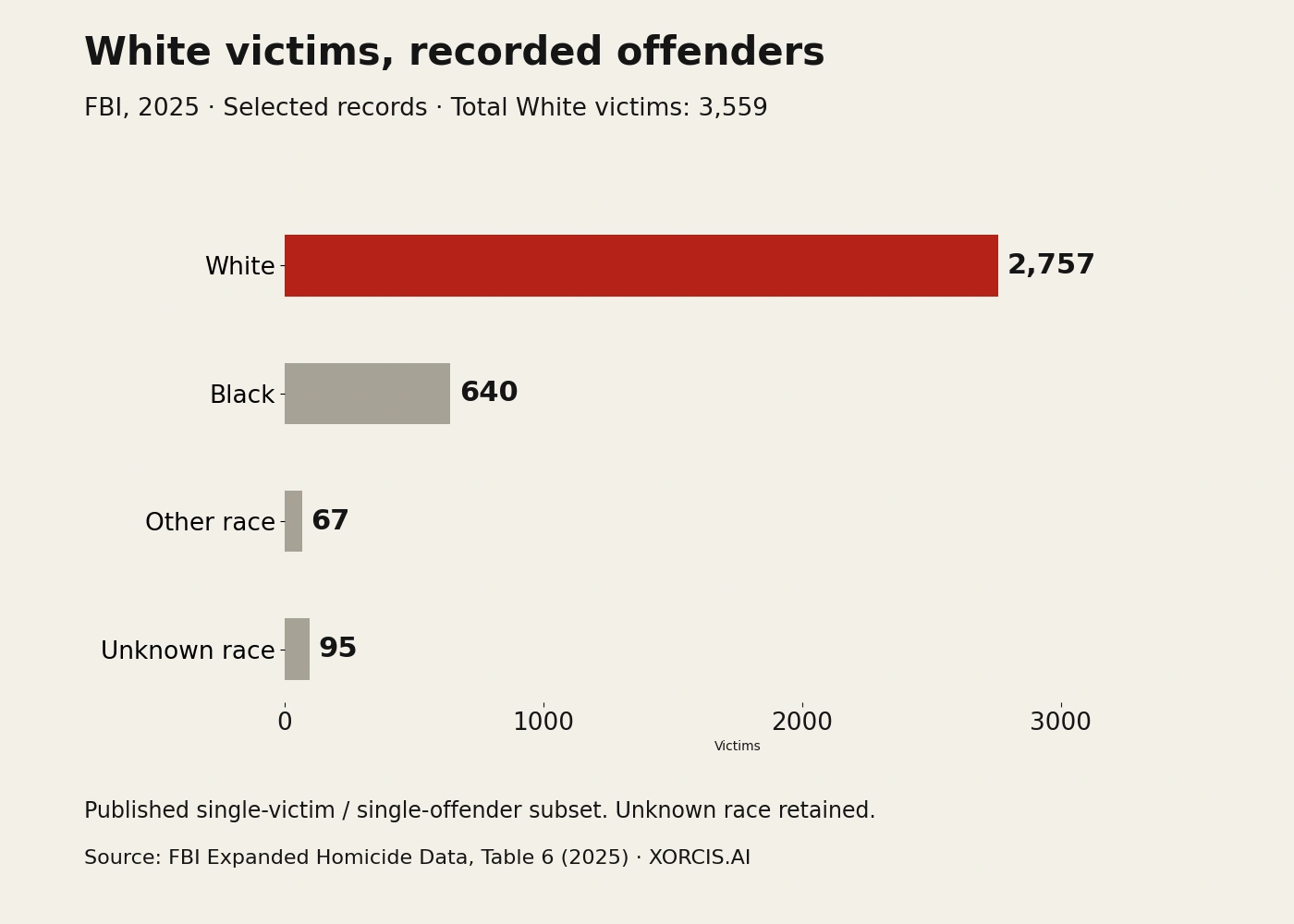
The FBI’s selected 2025 records listed White offenders for 2,757 of 3,559 White murder victims: 77.5%, including unknown offender race in the denominator. A majority of the victims in that row had a recorded offender of the same race. [1]
A separate BJS national estimate puts homicide victimization at 2.2 per 100,000 non-Hispanic White residents in 2024. That rate concerns victims, not offenders. It does not tell us the offender’s race in those deaths. [4]
The latest FBI annual release, published on 14 August 2026, reports an estimated national murder rate of 4.1 per 100,000 inhabitants in 2025 and an 18.1% decrease in murder and nonnegligent manslaughter offenses from 2024. That trend is a national estimate, not the selected White-victim row. [5]
Every entry concerns a person killed. A lower population rate does not make an individual death minor. A racial comparison does not restore a victim to a family.
The title’s trial language is forensic satire. A demographic table records categories; it does not charge a racial population. The title makes no claim about the outcome of individual prosecutions or about how every newspaper described the deaths.
“White-on-White crime” is a description of a racial pairing. Used carefully, it can identify a pattern worth examining. Used as an explanation, it leaves the central work undone.
The matching categories do not identify a motive, establish whether the people knew each other, or explain how a weapon became available. The phrase cannot distinguish a domestic killing from a robbery or a dispute between acquaintances.
The invention comes when an offender’s classification becomes a character reference for millions of unrelated people. No additional evidence appears at that moment. The accusation simply gets larger.
Start with the question being answered. “Among victims in this selected category, how many had a same-race offender?” is different from “How often does a population commit murder?”
The first question sorts victim–offender records. The second needs a population denominator and a defined measure of offending. A percentage in a victim row cannot become the percentage of White Americans who kill.
The next jump is from an observed association to a racial cause. Explaining a killing requires evidence about the conduct and circumstances. A matching race field does not perform that investigation.
Apply a consistency test: if same-race violence is used to accuse Black Americans collectively, would the same reasoning accuse White Americans collectively? Rejecting the second accusation while accepting the first is a double standard. Accepting both produces two unsupported accusations.
This is a test of the argument, not a measured claim that White violence is never racialized. Establishing a wider media pattern would require a defined sample and a comparison of actual coverage.
“Crime” is broader than homicide. The latest BJS victim survey verified here covers 2024. Table 13 estimates 1,706,750 nonfatal violent incidents with White victims and perceived White offenders out of 3,421,720 White-victim incidents. That is 49.9% including the 645,320 unknown-race-or-Hispanic-origin incidents, or 61.5% excluding unknowns. The estimates have sampling uncertainty; White means non-Hispanic White. The survey covers people aged 12 or older and crimes reported and not reported to police, not convictions. [3]
The homicide chart also has limits. It covers a published single-victim, single-offender subset, and records race and Hispanic ethnicity separately. [1] The FBI’s broader 2025 situation table separately lists 1,653 single-victim records with an unknown offender or offenders. Those cases cannot be assigned to a racial pairing without evidence. [2]
Same-race patterns do not mean equal population risk. BJS estimated homicide victimization at 18.3 per 100,000 non-Hispanic Black residents in 2024, substantially above the non-Hispanic White rate. The report uses weighting and imputation for missing data and nonresponse. Neither the unequal rates nor the shared pattern cancels any victim’s claim to protection. [4]
The specified records establish substantial violence against White victims by recorded White offenders. This update uses the 2025 FBI annual homicide tables and national trend, plus 2024 BJS survey and victimization estimates, verified on 1 October 2026. Data years, publication years and denominators remain distinct.
The evidence does not establish a criminal essence of whiteness. It does not prove that White communities ignore victims. It does not identify a defendant in a particular unresolved case.
The companion Black-on-Black crime article applies the same boundary. An offender can be investigated and prosecuted on individual evidence. A victim can receive recognition and a family can demand justice. Neither process requires racial relatives to inherit responsibility.
A consistent standard keeps the victim visible and the accusation attached to the conduct. The race field is a recorded attribute, not a substitute defendant.
What is answered, and what remains open. Question 1 is answered by the definitions and denominator above. Matching racial categories do not establish a cause for question 2. Question 3 asks whether individual responsibility is applied consistently.
- Which crime, year and denominator support the claim, and what happens to unknown offenders?
- What evidence explains the conduct beyond the matching racial categories?
- Would the same rule of individual responsibility be applied to a Black offender and a White offender?
The spreadsheet has a race column. Adding a collective defendant still requires evidence.
Sources
- [1] FBI, Expanded Homicide Data Table 6, 2025 (original Excel file). Retrieved 1 October 2026 from Crime Data Explorer, CIUS 2025, Expanded Homicide Tables. Original release packet (ZIP). Row totals and race classifications supply the chart.
- [2] FBI, Expanded Homicide Data Table 4, 2025 (original Excel file). Victim/offender situations, including unknown offenders; same official packet.
- [3] BJS, Criminal Victimization, 2024, September 2025, Table 13, page 14 and methodology. Legacy survey instrument. Percentages are XORCIS.AI calculations from published estimates, subject to rounding and sampling error; unknowns are identified explicitly.
- [4] BJS, Crime Known to Law Enforcement, 2024, March 2026, Table 5, page 10 and methodology. National estimates; race categories exclude Hispanic people. Homicide means murder and nonnegligent manslaughter.
- [5] FBI, 2025 Reported Crimes in the Nation release, 14 August 2026. Latest annual national crime estimates verified for this update; national trends and reporting coverage differ from the selected homicide table.