LG’s television can turn your viewing into an advertising product.
Section 1 of 10 · Introduction
LG’s television can turn your viewing into an advertising product.
You paid for the screen. A separate business can extract value from identifying what plays on it. Automatic Content Recognition makes that conversion possible. The question is whether the viewer understands the second transaction, can refuse it and can verify that refusal.
LG openly connects viewing recognition to its advertising business. Its September 2022 rollout announcement promoted household ad-exposure measurement, audience segmentation and campaign effectiveness. [6] The commercial purpose does not need to be inferred from a blinking light or a rumour about microphones. The company advertised it to advertisers.
LG’s current explanation says ACR identifies supported content through internal audio fingerprints, including Live TV, HDMI sources and LG Channels. It says ACR does not collect screenshots or recordings and does not operate inside third-party streaming apps installed through LG Apps. [1] An externally connected streaming device and the TV’s own app are therefore different cases.
In May 2026, Texas announced an LG settlement addressing informed consent and viewing-data disclosures. [5] This is a documented regulatory intervention. It does not establish that every owner was secretly monitored or that every device behaves identically.
ACR means Automatic Content Recognition. The invention examined here is a second use of the viewing event: entertainment becomes a behavioural trace, then an input to audience measurement or advertising. The television remains a display while also becoming a source of commercial information.
The difference matters because buying a product and agreeing to a data practice are separate decisions. A checkout receipt cannot explain which optional agreement was accepted later, what it permitted or whether the person who clicked was informed. Nor can a household identifier tell us which family member watched the programme.
Calling the result a fingerprint can make it sound harmless. It is a reduced representation, but one designed to identify something. The relevant question is what a recipient can learn or connect through that representation, not whether it resembles the original film frame.
LG Ad Solutions’ policy describes brief internal audio samples encoded on the device into signatures, matched against known commercial content. It says matched signatures can be associated with an IP address or device ID and shared for recommendations, ad targeting and measurement across associated devices; unmatched signatures are discarded. [2] That description concerns the service, not a packet capture from every LG model.
The policy also describes combining information from third-party providers and sharing with selected parties for business, marketing and analytics purposes. Its advertising opt-out section says collection may continue for other purposes. [2] Turning off one advertising use cannot automatically be read as withdrawing from every collection purpose.
Anselmi and colleagues’ 2024 study audited ACR network traffic on tested LG and Samsung sets in the UK and US. It found ACR traffic when TVs served as HDMI displays and found that the tested opt-outs stopped traffic to identified ACR servers. This was a bounded network audit, not decryption of every payload or a test of all firmware versions. [3]
A server connection is evidence of a connection. Identifying what left the household requires more. An audit should preserve the model, firmware, region, accepted agreements, input source and traffic observations. Without those conditions, “LG does this” can collapse several different implementations into one accusation.
LG says ACR is optional and off by default, with separate consent for viewing information and interest-based cross-device advertising. It distinguishes ACR from voice recognition and device discovery, denies continuous recording of household conversations, and says advertising partners do not receive ambient or voice audio through its advertising services. [1] These are LG’s representations, not an independent audit of a reader’s TV.
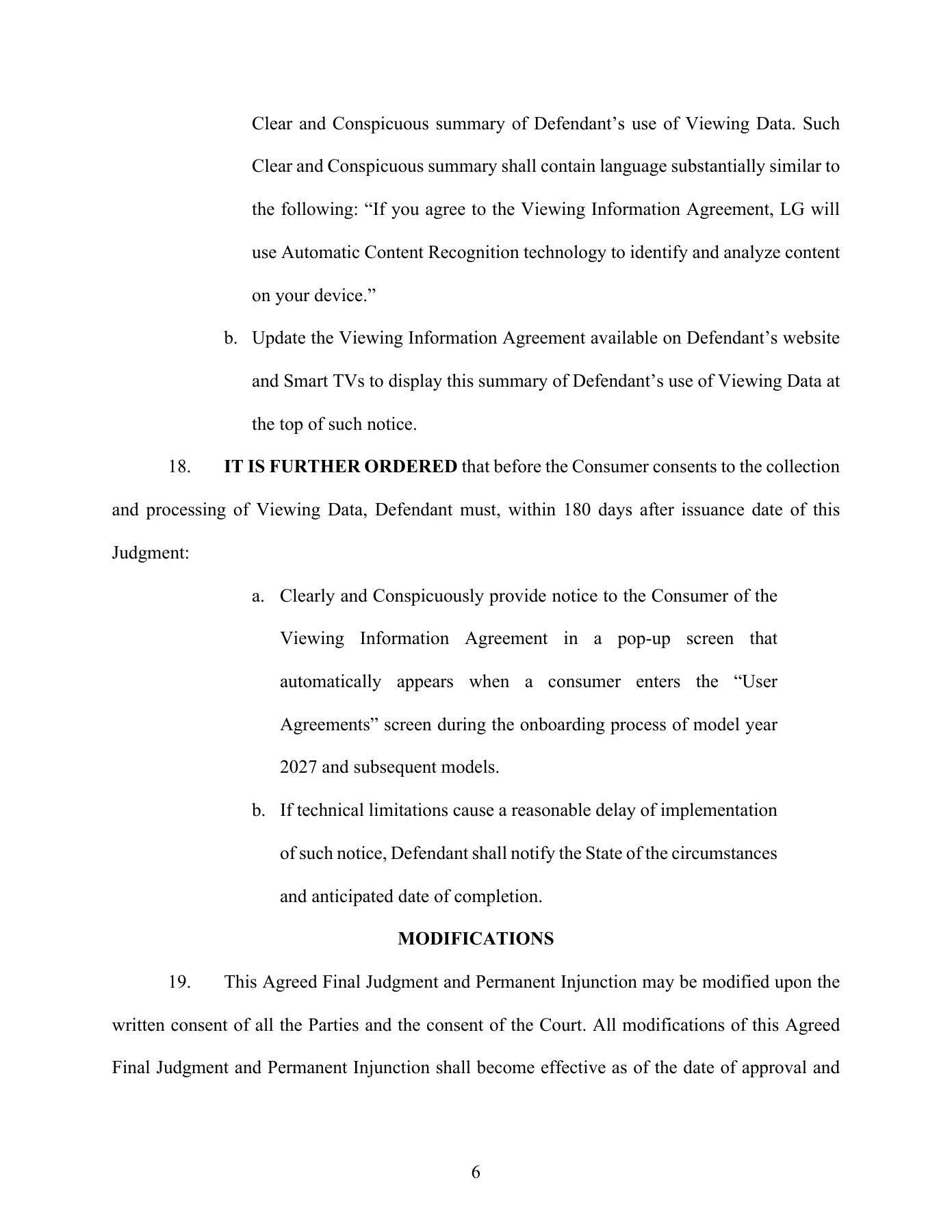
The Texas agreement requires affirmative informed consent and clearer notices, with deadlines and model-year qualifications. It expressly disclaims an admission of wrongdoing. It also stipulates that consumers’ viewing data has not been, and will not be, transmitted from the US to the People’s Republic of China. [4] Political language about China must not be substituted for proof that such a transfer occurred.
The company describes some sharing as potentially constituting a legal “sale” or “sharing” in relevant markets. [1] Those legal categories do not necessarily mean somebody purchased a named person’s viewing diary. Device-linked advertising data still deserves scrutiny without inventing a transaction the sources do not show.
LG’s documented path on some models is Settings → All Settings → General → Additional Settings → Live Plus → Off. [7] Other webOS versions move controls; use the model’s guide rather than assuming one menu fits every set. Review the optional Viewing Information and advertising agreements as separate choices.
LG says optional agreements can be withdrawn through TV settings. [1] Record the model, firmware, region and settings before and after changing them. The expected result of disabling ACR is to disable that recognition feature; it is not a promise to erase past data or stop every connection from the TV and its apps.
For a device used only as a display, leaving its own network connection disabled removes that direct upload route. An attached streaming box still has its own network connection and privacy practices. Physical disconnection and deletion of previously collected information are different operations.
The sources establish a viewing-recognition business, disclosed partner uses, measurable ACR traffic in tested conditions and specific consent commitments. They do not establish universal microphone surveillance, a single behaviour across all LG televisions or that every firmware update complies with the published promises.
The privacy question is still concrete: can a customer use a purchased screen without supplying viewing information for advertising, and can the customer verify the answer? A buried agreement is technically available information. Meaningful choice requires that its consequences are understandable at the point of decision.
The next case examines the other direction of control: Amazon’s Iliad cancellation process. Here the commercial resource is viewing information. There it is the payment that survives an attempted departure. Both require examining how a person’s “no” travels through the interface.
What is answered, and what remains open. The functions and disclosed purposes are documented. Compliance on a particular television, the complete recipient chain and the effects of withdrawal need device-specific evidence.
- Which agreement authorized recognition on the particular model and input, and what did the viewer actually see before accepting it?
- Which recipients can connect the viewing fingerprint or device identifier to other information, and which purposes survive an advertising opt-out?
- After Live Plus or viewing consent is disabled, what repeatable network evidence verifies that the relevant ACR traffic stops?
The screen came with a price. The audience came with another.
Sources
- LG, Understanding Privacy on LG Smart TVs, September 2026: current company explanation; read 15 October 2026. Company claims retain attribution and market qualifications.
- LG Ad Solutions / Alphonso, privacy policy: audio signatures, identifiers, partners and separate opt-out purposes; read 15 October 2026.
- Anselmi et al., Watching TV with the Second-Party, ACM IMC 2024: black-box audit, HDMI and opt-out findings; results apply to tested devices and conditions.
- State of Texas / LG, published Agreed Final Judgment and Permanent Injunction: definitions, disclaimers, stipulations and notice requirements, pp. 2–6. Published copy’s judicial date/signature field is blank.
- Texas Attorney General, LG settlement announcement, 11 May 2026: the enforcement authority’s account of the agreement.
- LG, ACR global rollout announcement, 15 September 2022: the company’s own explanation of the advertising business purpose.
- LG support, Flickering Video from X-Box HDR Gaming: documents a Live Plus settings path on covered models, not a universal privacy guide.
No reader’s television or network was tested. Fingerprints, microphone processing and screen recordings are distinguished. The published Texas agreement does not establish local implementation or a global rule. The thumbnail is AI-generated conceptual art; the lead image is a page of the published legal agreement.