Cornell rape complaint alleges essays could soften the consequences.
Section 1 of 9 · Introduction
Cornell rape complaint alleges essays could soften the consequences.
A rape allegation, a disputed disciplinary response, and the difference between “essays” and “only essays.”
By Al Agami · XORCIS.AI · 1 October 2026
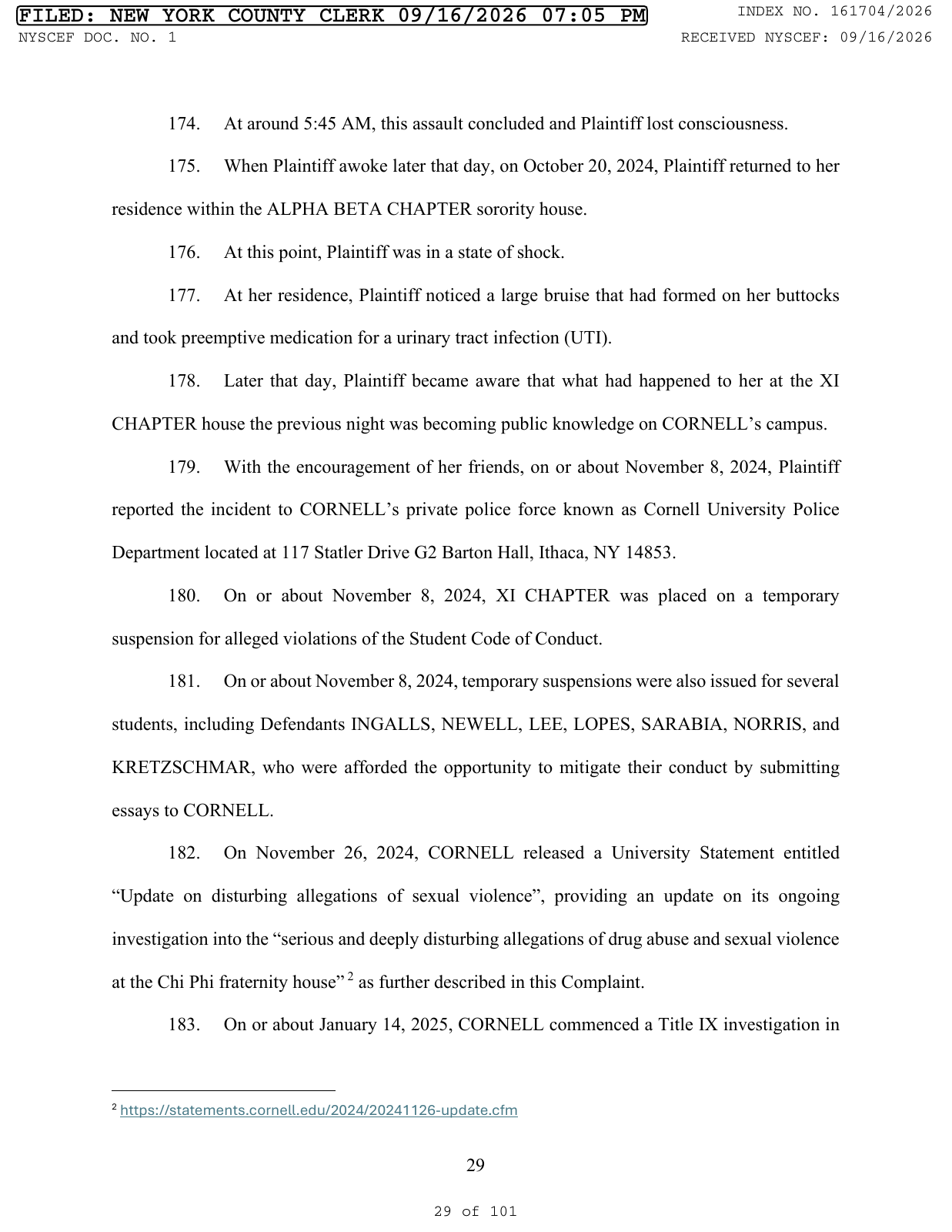
A former Cornell student, identified as Jane Doe, alleges that seven fraternity members sexually assaulted her at the Chi Phi house in October 2024. Her civil complaint was filed on 16 September 2026. Its allegations are not court findings.
Paragraph 181 contains the claim at the centre of this article. It alleges that students issued temporary suspensions in November 2024 “were afforded the opportunity to mitigate their conduct by submitting essays” to Cornell. The paragraph does not say essays were their only punishment. It also does not explain what the assignments required or what submitting them changed.
Cornell subsequently said its proceedings resulted in expulsions and suspensions. The university denied that essay-writing was the sole consequence offered to anyone involved. Its public statement did not specify how many students received each sanction.
An essay is evidence that someone can produce an essay. Whether it demonstrates understanding, remorse or changed behaviour requires a separate assessment.
If writing was used to mitigate consequences, as the complaint alleges, the institution had to make a consequential judgment: what should a student’s account of their conduct change about the response to that conduct?
The assignments and the decisions attached to them have not been established by the records examined for this article. We therefore cannot claim that Cornell exchanged essays for forgiveness. We can identify the question its public response leaves open.
Three different propositions have become entangled:
- Essays were offered.
- Essays could mitigate consequences.
- Essays were the only consequences.
The complaint alleges an opportunity to mitigate conduct through essays. Cornell’s published denial addresses essays as the sole consequence. Those propositions are not logical opposites: an assignment could influence a disciplinary decision while other sanctions remained in place. That is an analysis of the wording, not proof that such an arrangement occurred.
This distinction matters because public outrage can compress an allegation into a slogan, while an institutional response can rebut the slogan without fully answering the allegation underneath it.
“What else happened?” and “What did the essays change?” are separate questions.
Cornell’s account must be included. The university describes a months-long Title IX investigation followed by a hearing, with opportunities for the complainant and respondents to present evidence. It reports suspensions and expulsions and says the fraternity chapter remains barred from campus. These statements contradict a sweeping claim that the university imposed no substantial consequences.
They do not provide a complete account of the essay assignments. Nor should different accused students automatically be treated as having identical conduct, findings or sanctions. Lawyers for some defendants have denied the allegations against their clients.
Individual responsibility needs individual evidence. Institutional accountability needs evidence of how decisions were made.
The complaint proves that an allegation about essays entered the court record. It does not, by being filed, prove the allegation true.
Cornell’s statement proves that the university publicly denied essays were the sole consequence and reported other sanctions. It does not independently demonstrate that every sanction was proportionate or explain whether an essay reduced, shortened or otherwise affected one.
The records examined here establish a dispute over disciplinary accountability. They do not justify the headline “Seven rapists were punished only with essays.” That formulation presents contested guilt and an unestablished account of punishment as settled facts.
Precision preserves the question worth investigating: were essays used to mitigate consequences, and on what basis?
What is answered, and what remains open. These three questions remain open in the record reviewed here. The article reports the essay claims with attribution; it does not establish their disciplinary purpose, effect or an independently verified explanation from Cornell.
- What were the essays for? Were they educational requirements, submissions seeking mitigation, or something else?
- What did they change? Did completing an assignment affect suspension, return to campus or another disciplinary condition?
- What can be verified? Can Cornell provide an independently assessed explanation of its decisions while protecting the complainant’s privacy and individual student information?
A university can require reflection. The test is whether it can account for what that reflection was allowed to change.
If an essay helped reduce a consequence, the public question is not whether it had a conclusion. It is who signed off on it.
Sources
- Jane Doe v. Cornell University et al., New York Supreme Court, index 161704/2026, complaint filed 16 September 2026; paragraph 181, PDF page 29. Primary record for the essay allegation.
- The Cornell Daily Sun, 28 September 2026, reporting Cornell’s statement on essays, suspensions and expulsions. Cornell’s original statement could not be retrieved directly during this research.
- ABC News, 27 September 2026, reporting the reopened investigation and responses from defendants.